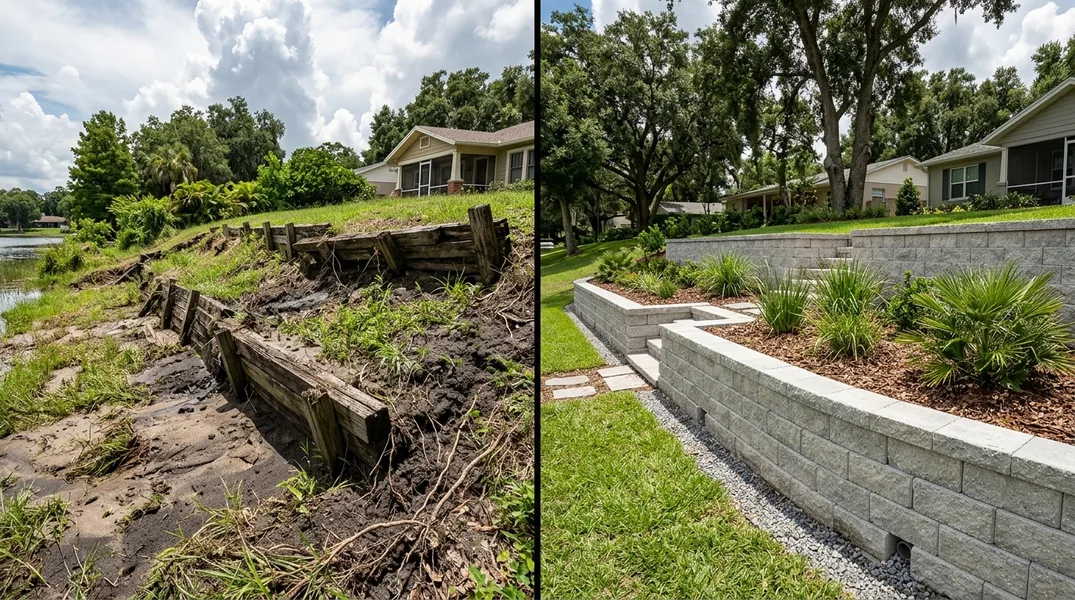
Why Orlando's Rainy Season Is So Hard on Retaining Walls
If you live in Orlando, you already know the pattern: long, sunny afternoons followed by sudden, heavy downpours that can dump inches of rain in under an hour. Between June and September, the region receives the bulk of its annual rainfall, and that water has to go somewhere. When it saturates the soil behind a retaining wall, it creates one of the most destructive forces a wall will ever face: hydrostatic pressure.
Hydrostatic pressure is simply the weight of water pushing against a surface. In a retaining wall, that surface is the back of the wall itself. Dry soil exerts a manageable load. Saturated soil can weigh dramatically more, and when water cannot escape, it presses outward with tremendous force. A wall that performed perfectly in the dry season can begin to lean, crack, or bulge after just a few weeks of heavy summer storms. This is why retaining wall drainage is not an optional add-on in Central Florida. It is the single most important factor in whether a wall lasts decades or fails in a few seasons.
How Hydrostatic Pressure Quietly Destroys a Wall
The damage rarely happens all at once. Water seeps into the backfill soil and fills the void spaces between particles. If the wall lacks a path for that water to drain away, the saturated soil becomes heavy and fluid-like, pushing against the wall with far more force than it was designed to handle. Over time, this hydrostatic pressure retaining wall problem shows up as horizontal cracks, a leaning top course, or blocks that begin to separate and shift. In severe cases, the entire wall can rotate forward or collapse after a single intense storm.
What makes this so frustrating for homeowners is that the warning signs are easy to miss. A slight lean or a hairline crack may seem cosmetic at first. But once a wall starts moving, the problem accelerates. Water finds the new gaps, saturates more soil, and increases the pressure further. By the time the damage is obvious, the repair is often far more involved than a simple fix. This is why we encourage homeowners to treat any change in a wall's shape or alignment as a reason to call a professional for an inspection.
The Role of a Retaining Wall French Drain
The most effective defense against hydrostatic pressure is a properly designed retaining wall french drain. This system typically combines a perforated pipe at the base of the wall, a bed of clean gravel, and a filter fabric that keeps soil from clogging the pipe. As water enters the backfill, it flows through the gravel and into the pipe, which carries it safely away from the wall. When installed correctly, a french drain keeps the soil behind the wall relatively dry, which keeps the pressure on the wall within safe limits.
The details matter enormously. The pipe must slope correctly so water actually flows, the gravel must be the right size and depth, and the filter fabric must be placed to prevent fine soil particles from washing in and blocking the system. Weep holes alone are rarely enough in Central Florida's heavy rains. A complete drainage design also considers surface water, roof runoff, and the slope of the surrounding yard. If you are planning a new wall, make sure drainage is part of the conversation from day one. If you already have a wall that shows signs of water damage, a professional can assess whether the existing drainage can be improved or whether Retaining Wall Repair is needed to address structural movement.
Warning Signs Your Retaining Wall Drainage Is Failing
Homeowners in Winter Park and throughout the region often ask us how to tell whether their wall has a drainage problem. The most common signs include water pooling at the base of the wall after storms, soil washing out from behind the wall, and visible efflorescence (a white, chalky stain) on concrete or block surfaces. You may also notice that the wall leans slightly, that joints have opened up, or that the ground behind the wall has settled into a depression.
Another red flag is persistent dampness along the back of the wall even days after rain. If the soil stays saturated, the drainage system is either missing, clogged, or improperly designed. In some cases, tree roots or sediment have blocked the outlet, and the water has nowhere to go. Ignoring these signs during the rainy season is risky because each storm adds more pressure. A timely inspection can often catch a failing drain before it causes structural damage, saving you from a much larger repair bill later.
Retaining Wall Installation Near Me: Getting Drainage Right From the Start
The best way to avoid drainage failures is to build the wall correctly the first time. When we handle Retaining Wall Installation, we design the drainage system around the specific soil, slope, and water flow of your property. That means proper excavation, a compacted gravel base, a correctly sloped french drain, filter fabric, and clean backfill. We also account for how water moves across your yard, so the wall is not fighting runoff from a driveway, roof, or uphill neighbor.
If you are searching for retaining wall installation near me in the Sanford area or anywhere in Central Florida, choose a contractor who treats drainage as a core part of the job, not an afterthought. A wall without proper drainage is a temporary structure at best. A wall with a well-designed drainage system can serve your property for decades. We are happy to review your project and explain exactly how we would protect it from water damage. Call (407) 955-9875 or request a free estimate to get started.
When to Repair, Replace, or Rebuild for Better Drainage
If a wall is already showing movement or water damage, the right solution depends on how far the problem has progressed. Minor issues, such as a clogged drain or a small area of settled backfill, can often be corrected with targeted Retaining Wall Repair. But when a wall has leaned significantly, developed wide cracks, or begun to fail structurally, patching it may only delay the inevitable. In those cases, Retaining Wall Replacement with a properly engineered drainage system is usually the safer and more cost-effective long-term choice.
For homeowners who want maximum durability, Concrete Retaining Walls offer excellent strength and can be designed with integrated drainage details. Whatever material you choose, the drainage plan should be tailored to your site. If you are unsure which path makes sense, a professional assessment can clarify your options and help you avoid spending money on repairs that will not last. To discuss your wall and get a clear picture of the pricing involved, reach out to our team at (407) 955-9875.
Looking for a professional retaining wall contractor in Orlando? Orlando Retaining Wall responds fast for all your retaining wall needs.
Get a Free QuoteOur services: Retaining Wall Installation · Retaining Wall Repair · Retaining Wall Replacement