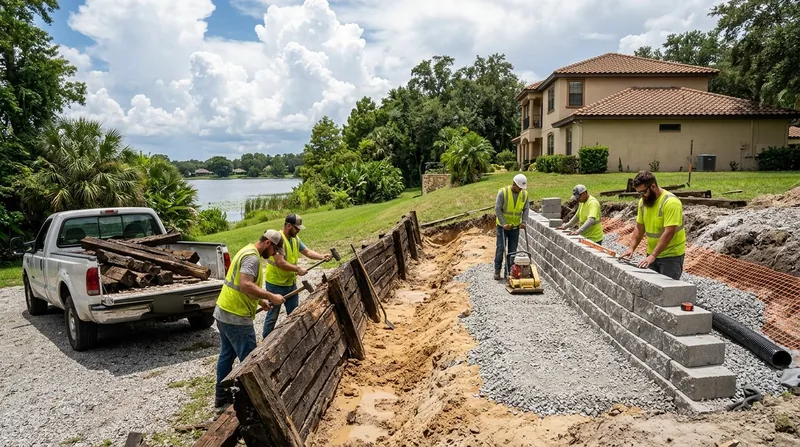




Orlando sits on sandy ground over karst limestone, flat across most of the city but broken by lakes and gentle slopes that run down to the water. In College Park, Thornton Park and Lake Eola Heights, 1920s and 1930s bungalows still have railroad tie walls holding up driveways and planters, and many of those creosote-treated ties from the 1980s and 90s are now rotted, leaning or collapsing after years of saturated sand and hurricane rain. Railroad Tie Wall Replacement in Orlando means pulling out those failing ties, hauling them away, fixing the drainage and rebuilding the wall in segmental block, concrete or natural stone so it holds for decades. We handle the demolition, the gravel backfill and the rebuild, and we tell you straight if a repair makes more sense than a full replacement. If your wall is already leaning or has collapsed, start with our leaning and collapsed wall repair page before you plan the rebuild.
Why Railroad Tie Walls Fail Faster in Orlando's Sandy Soil
Orlando's afternoon storms dump inches of rain in under an hour, and that water moves fast through sandy soil. Old railroad tie walls were often built with little or no gravel backfill and no drainage outlet, so the sand behind them saturates, gains weight and pushes the ties outward. Creosote-treated timber also rots faster in Central Florida's humidity than most homeowners expect, and the ties crack and split as they dry out between storms.
- We see ties that have rotted through at the soil line, which is the first place water sits.
- Saturated sand behind the wall adds hundreds of pounds of pressure per foot during a summer storm.
- Walls built without weep holes or gravel backfill trap water and lean within a few seasons.
- Karst limestone settling under the footing lets the whole wall drop and separate.
- Creosote ties near pools, decks and vegetable gardens are also a health and odor concern for many families.
If your tie wall is bulging, leaning or losing height, the sooner we look at it the less likely the fix turns into a full rebuild with slope stabilization.
Key info: A tie wall along a lake bank in Winter Park or a driveway in College Park can look fine on the surface while the backfill is already saturated. We probe the soil and check the footing before we quote, because a wall that is only leaning often needs drainage and reinforcement rather than full replacement.
For official guidance on when a retaining wall needs a permit in Orlando, check the City of Orlando building department and Orange County permitting pages before you schedule work. Thresholds vary by jurisdiction, and a wall over roughly 4 feet measured from the footing, or one that supports a driveway or structure, usually triggers a permit and may need engineered drawings. City of Orlando permits
How We Replace a Railroad Tie Wall in Orlando, Step by Step
Every replacement starts with the same question: what is the wall holding up, and where does the water go? We walk the property, check the slope, look at the soil and the footing, and confirm whether the wall sits on a property line or near a lake bank. Then we plan the demolition around your access, your landscaping and any pool or deck the wall supports.
- We locate utilities and confirm the property line and any setback rules with the local building department.
- We remove the old ties, posts and rotted backfill and haul the creosote-treated material to an approved disposal site.
- We excavate to the footing, compact the base and set a gravel drainage layer with filter fabric.
- We install perforated pipe and weep holes so storm water exits the wall instead of pushing it over.
- We rebuild in segmental block, poured concrete or natural stone, compacting lifts of backfill as we go.
- We cap the wall, clean the site and walk you through the drainage and the finished grade.
On lakefront lots in Baldwin Park or along the Winter Park chain of lakes, we also check the bank above and below the wall, because a failing tie wall often takes some slope with it.
Key info: On a recent job near Lake Eola Heights, the old tie wall behind a 1930s bungalow had no gravel backfill at all. We pulled the ties, rebuilt the drainage with washed gravel and perforated pipe, and set a segmental block wall. The homeowner gained about 18 inches of usable patio space because the new wall could be built tighter to the slope.
If the wall sits on a slope that has already started to wash out, we bring in our slope stabilization and erosion control crew before the rebuild so the new wall is not fighting a moving hillside.
Replacement Approaches We Use in Orlando
Not every tie wall should be replaced with the same material. A low planter wall in Thornton Park, a lake bank in Kissimmee and a driveway wall in Clermont all carry different loads and see different water. We match the approach to the site, the soil and how you want the finished wall to look.
| Approach | Description | Best for |
|---|---|---|
| Segmental block | Interlocking engineered blocks with gravel backfill and drainage pipe. | Driveway walls, lake banks and tiered walls up to 4 feet or more with engineering. |
| Poured concrete | Reinforced concrete wall, often stuccoed to match the house. | Pool deck and planter walls where a smooth, finished face matters. |
| Natural stone or boulder | Fieldstone or boulder wall set into the slope with gravel drainage. | Garden walls, waterfront banks and homes that want a natural look. |
| Timber (new treated) | Modern pressure-treated timber with proper drainage and deadmen. | Low garden walls under 3 feet where budget is the priority. |
| Hybrid repair and rebuild | Keep sound sections, replace failed runs, add drainage and reinforcement. | Long walls where only part of the run has failed. |
We will tell you which approach fits your wall and your budget, and we will not sell you a full rebuild if a partial replacement will hold.
Railroad Tie Wall Replacement Cost in Orlando: What to Expect
Most railroad tie wall replacements in Orlando start around $35 per square foot of wall face, and that figure covers demolition, haul-away of the treated ties, new gravel backfill and drainage, and a rebuild in a standard material. The number moves up or down based on the length and height of the wall, how much of it has failed, and how hard it is to get equipment and material to the site.
Access is the biggest wildcard. A wall behind a College Park bungalow with a narrow side yard takes more labor than a wall along an open driveway in Lake Nona. Lakefront walls in Winter Park or Kissimmee can need bank work and erosion control before the wall goes back in. Taller walls, tiered walls and walls that support a driveway or structure may need engineered drawings and a permit, which adds design and inspection cost. Old creosote ties also cost more to dispose of than clean concrete or block.
Get two or three written estimates and compare what is included, not just the total. A low bid that skips the gravel backfill or the drainage pipe will cost you again in a few seasons. Our full pricing overview breaks down what each line item covers so you can compare bids fairly.
What to Look for When Hiring a Retaining Wall Contractor Near Me in Orlando
Retaining wall work is structural, and a bad install shows up fast in Florida's rain and sandy soil. Before you sign, confirm the contractor is fully insured in Florida, ask for the certificate of insurance, and check that the policy covers both general liability and workers' compensation. Ask for references from jobs in Orlando or the surrounding cities and call them.
Ask who pulls the permit and whether the wall needs engineered drawings. If the wall is near a lake bank or a protected tree, the contractor should know the local rules and the HOA requirements for your community. A contractor who shrugs at permits or drainage is a contractor who will leave you with a leaning wall in two years.
Reach out through our contact page to schedule a free estimate, and we will give you a straight answer on repair versus replacement.
Railroad Tie Wall Replacement in Orlando: Pricing Guide
| Service | Price | Details |
|---|---|---|
| Railroad tie wall replacement, standard access | Starting at $35/sq ft | Includes tie demolition, haul-away, gravel backfill, drainage pipe and rebuild in standard segmental block. |
| Railroad tie wall replacement, tight access | Starting at $45/sq ft | Narrow side yards and rear-lot walls where equipment and material must be moved by hand. |
| Lakefront or slope replacement | Starting at $55/sq ft | Adds bank work, erosion control and heavier drainage for walls sitting on a slope down to the water. |
| Tall or engineered wall replacement | On estimate | Walls over roughly 4 feet or supporting a driveway need an on-site look, engineering and permit review before pricing. |
| Travel | Included | Included in Orlando and surrounding areas, no separate call-out or mileage fee. |
| Estimate | Free | Response within 24 hours at (407) 955-9875, no obligation to book. |
Indicative pricing, the exact cost depends on square footage, finish, and site access. Free personalized estimate within 24h at (407) 955-9875.


