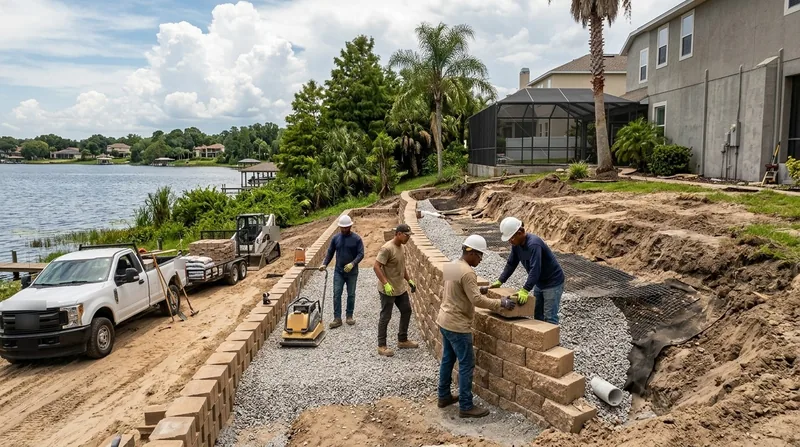




Orlando sits on deep sandy soil over karst limestone, and most of the city is flat until you hit the lake banks and the rolling ground out toward Clermont. That flatness is deceptive. A yard that slopes gently down to Lake Eola, a pond in Baldwin Park, or a canal in Lake Nona still moves a lot of water when a summer storm dumps two inches in an hour. Retaining Wall Installation in Orlando is how you hold that grade, protect the house pad, and keep the sand where it belongs. We build walls for lakefront lots, raised pads, pool decks, and driveways across the metro, with footings, gravel backfill, and drainage sized for Central Florida sand. If a wall is already leaning or bulging, start with leaning and collapsed wall repair before you plan anything new.
Why Retaining Wall Installation Matters on Orlando's Sandy, Lake-Dotted Ground
Orlando's soil is the whole story. Sandy ground drains fast until it doesn't, and after a week of afternoon storms the sand behind an old wall turns into a heavy, saturated mass pushing downhill. Add the lake banks around Winter Park and College Park, the raised pads in Lake Nona, and the 1920s bungalow lots on brick streets, and you get walls that fail from washout and settling rather than frost. That is why a new wall here needs real drainage and a footing that reaches competent ground.
- We set footings below the disturbed topsoil so the wall bears on stable sand, not fill.
- We install gravel backfill and perforated drain pipe to relieve storm water before it loads the wall.
- We match the wall type to the job: segmental block on lake banks, poured concrete at pool decks, boulder where the grade rolls west toward Clermont.
- We check the surcharge. A wall holding a driveway or a structure carries far more load than a planter wall.
Get the drainage and footing right and a wall holds for decades. Skip either one and you are back to repair within a few hurricane seasons.
Key info: In College Park and Thornton Park we regularly find 1930s timber walls rotting behind the original stucco. The sand behind them is already saturated, so we plan drainage before we set a single block.
For permit thresholds and inspection requirements, check with the City of Orlando building department or Orange County before work starts: orlando.gov/Building. Rules vary by jurisdiction and by wall height.
How We Build a Retaining Wall in Orlando, Step by Step
Every wall starts with a walk of the site and a grade check. We look at where the water goes now, what the wall has to hold back, and how a machine gets to the work area. On tight lots in Maitland or Winter Park, access drives the plan as much as the engineering does. Here is the sequence we follow on a typical installation.
- We mark utilities and confirm the property line and any setback rules with the local building department.
- We excavate to the footing depth and compact the base before anything else goes in.
- We set and compact the base material, then build the wall in lifts, checking level and batter as we go.
- We place gravel backfill and the drain pipe, then filter fabric to keep sand out of the gravel.
- We cap the wall, backfill the grade, and restore the lawn or plantings.
On lakefront work in Baldwin Park we often tie the wall into a short section of bank protection so the water has somewhere to go during a hurricane rain event. For lots with a steep run of grade, we coordinate with our slope stabilization and erosion control work so the wall and the slope above it are designed together.
Key info: A recent job off Alafaya Trail in east Orlando had a raised pad dropping three feet to a pond. We built a segmental block wall with a gravel drain behind it, and the wall has taken two hurricane seasons without movement.
Wall Types We Install Across the Orlando Area
The right wall depends on height, load, finish, and budget. A pool deck in Dr. Phillips wants a clean poured face. A lake bank in Winter Park often wants natural stone. A driveway wall in Apopka usually comes down to segmental block on cost and speed. We build all of them and we will tell you which one fits your site.
| Approach | Description | Best for |
|---|---|---|
| Segmental block | Interlocking units with gravel backfill and drain pipe | Lake banks, driveways, terraced yards |
| Poured concrete | Reinforced wall with formed face, stucco or veneer finish | Pool decks, planter walls, structural loads |
| Boulder and natural stone | Gravity wall built from graded rock | Rolling grade toward Clermont, natural look |
| Timber | Treated timber wall for low heights and garden terracing | Short garden walls, budget installations |
Each of these needs the same drainage discipline. The material changes the look and the price, not the physics.
Retaining Wall Installation Cost in Orlando: What to Expect
Most installations here start around $30 per square foot of wall face, and that figure is a starting point, not a quote. A four-foot segmental wall on flat ground in Oviedo sits near the low end. A tall tiered wall on a lake bank in Winter Park, with limited machine access and engineered drawings, moves well above it. The wall face is only part of the number.
What moves the price: wall height and length, material choice, footing depth, how much soil has to be excavated and hauled, drainage runs, access for equipment, and whether the job needs a permit and stamped drawings. Surcharge loads from a driveway or structure add cost because the wall has to be built heavier. Getting two or three estimates is smart because the scope, not just the price, varies a lot between contractors. Our full breakdown is on the pricing page.
Choosing a Retaining Wall Contractor Near Me in Orlando
Ask three things before you sign anything. First, is the contractor fully insured for this work, and can they show you a certificate? Second, will they pull the permit if the wall height or surcharge requires one, or are they going to leave that to you? Third, can they give you references from jobs in your part of town, not just photos?
Also check your HOA rules if you live in a planned community like Lake Nona or Baldwin Park, because wall material and height often need approval. Walk the site with each bidder and see whether they talk about drainage. A contractor who quotes a wall without discussing water is quoting half a job. To set up a walkthrough, use our contact page.
Retaining Wall Installation Near Me: What Orlando Homeowners Should Know
Orlando's failure mode is water, not frost. Summer storms and hurricane rain saturate the sand behind a wall, and that is when old timber and underbuilt block walls start to lean. The busiest stretch for new installations runs from late spring through the fall storm season, when homeowners finally see the washout. Winter and early spring are the easiest months to schedule, and the dry weather makes excavation and compaction cleaner.
If your existing wall is already bulging, do not wait for the next storm. Call (407) 955-9875 and we will tell you whether repair or replacement makes sense. For a broader look at what we do, start at the homepage.
Retaining Wall Installation in Orlando: Pricing Guide
| Service | Price | Details |
|---|---|---|
| Segmental block wall | Starting at $30/sq ft | Includes base, block, gravel backfill and drain; height and access move the price |
| Poured concrete wall | Starting at $45/sq ft | Formed and reinforced wall with finish; surcharge loads and finish work add cost |
| Boulder and natural stone wall | Starting at $40/sq ft | Gravity rock wall with filter fabric; rock size and haul distance drive the number |
| Timber wall | Starting at $25/sq ft | Treated timber for low garden walls; short heights and simple access keep it low |
| Complex or large-scale job | On estimate | Tiered, engineered, or tight-access walls need a site walk before pricing |
| Estimate | Free | Response within 24h at (407) 955-9875, no obligation to book |
Indicative pricing, the exact cost depends on square footage, finish, and site access. Free personalized estimate within 24h at (407) 955-9875.


