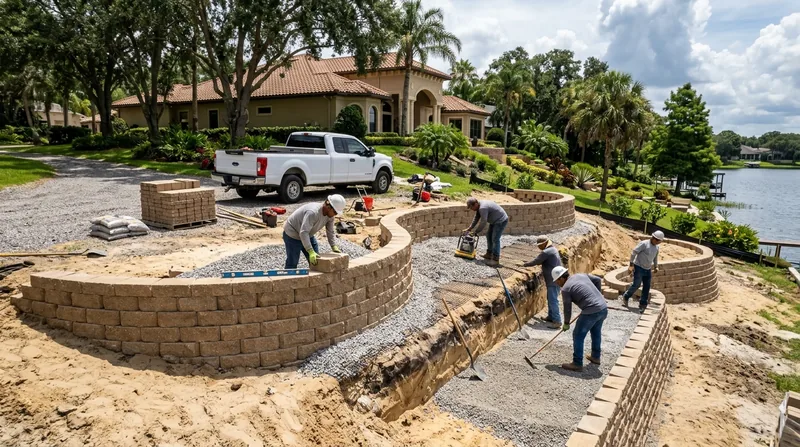




Block & Segmental Retaining Walls in Orlando: Built for Sandy Ground and Summer Storms
Orlando sits on sandy Central Florida ground over karst limestone, and most of the city is flat except where yards slope down to a lake. That mix is exactly why Block & Segmental Retaining Walls in Orlando are the go-to system for lakefront terraces, raised beds, and driveway edges. From the 1920s bungalows in College Park to the newer raised pads in Lake Nona, homeowners need walls that hold back saturated sand after an afternoon storm. We install Allan Block, Versa-Lok, and Keystone systems with geogrid reinforcement, engineered to move with the ground instead of cracking like poured concrete. If you are still weighing your options, start with our retaining wall installation overview before you pick a material.
Why Segmental Block Walls Make Sense on Orlando's Sandy, Lake-Dotted Lots
Orlando's soil drains fast when it is dry and turns into a moving mass when a summer cell dumps two inches in an hour. A mortarless segmental wall flexes with that movement, while a rigid wall fights it and loses. That is the core reason we push block and SRW systems on lake banks from Winter Park to Clermont. The dominant failure mode here is saturated sand pushing out a wall that has no drainage stone or geogrid behind it.
- Segmental block handles minor settling without cracking, which matters on karst limestone ground.
- Geogrid reinforcement ties the wall back into the slope, so saturated sand cannot push it over.
- Weep holes and gravel backfill let storm water escape instead of building pressure behind the block.
- Curves and tiered terraces are easy with block, which suits lakefront yards in Baldwin Park and Winter Garden.
- Block walls can be repaired block by block, unlike a cracked poured concrete face.
If your wall is already bulging or leaning, our leaning and collapsed wall repair crew can often reset and re-reinforce it instead of tearing it out.
Key info: A segmental wall on a lake lot in Winter Park failed after Hurricane Ian rain because the original builder skipped gravel backfill. We rebuilt it with geogrid and a French drain, and it has held through two more storm seasons.
For permit thresholds and inspection rules, check the City of Orlando Permitting Services site at orlando.gov before you schedule work.
How We Build a Block Wall in Orlando, Step by Step
Every wall starts with a footing trench dug down to stable soil, not just the sandy top layer. We set a compacted gravel base, then lay the first course dead level because every course above it depends on that line. Geogrid goes in every two to three courses, tied back into the slope. We finish with drainage stone, filter fabric, and a cap course, and we compact as we backfill.
- We mark the wall line and call 811 so utilities are flagged before we dig.
- We excavate a footing trench and compact a gravel base to grade.
- We set the first course level and check it with a laser before stacking block.
- We install geogrid layers tied back into the retained soil as the wall rises.
- We backfill with clean gravel, wrap it in filter fabric, and add weep holes.
- We cap the wall and clean the site, then walk you through the drainage outlets.
Walls over four feet, or walls carrying a driveway or structure, usually need a permit and sometimes engineered drawings, so we check with the local building department before we order block.
Key info: On a sloped lot in Clermont, the grade dropped six feet from the house to the street. We built a two-tier Versa-Lok wall with geogrid in both tiers, which let the homeowner keep a flat lawn instead of a steep, eroding bank.
If your existing wall is timber or railroad tie, see our railroad tie wall replacement page for the swap to block.
Block Wall Approaches We Use Across Orlando
Not every yard needs the same system. The right choice depends on height, load, curve radius, and how much room you have behind the wall for geogrid. Here is how the main approaches compare on Orlando soil.
| Approach | Description | Best for |
|---|---|---|
| Allan Block | Pinless block with a rear lip, easy to curve and tier. | Lakefront terraces and garden walls under four feet. |
| Versa-Lok | Solid, heavy block that stacks straight and takes geogrid well. | Tall walls and driveways with a surcharge load. |
| Keystone | Fiberglass pin system with a proven engineered design. | Structural walls on slopes in Clermont and Apopka. |
| Tiered block wall | Two or more stepped walls with planted benches between. | Steep lake banks where one tall wall would look heavy. |
We size the block and geogrid to your wall height and soil, not to a one-size catalog spec.
Block & Segmental Retaining Walls Cost in Orlando: What to Expect
Most block walls in Orlando start around From $25/sq ft for a straightforward garden or terrace wall under four feet. That figure covers block, base gravel, drainage stone, filter fabric, and labor. Taller walls, tight access behind a pool cage, or a wall that needs engineered drawings push the number up. Lakefront lots in Winter Park and Kissimmee often add cost because we have to haul material across soft ground or work from the water side.
- Wall height and tier count drive the block and geogrid quantity more than anything else.
- Access matters: a wall behind a Baldwin Park townhome is slower to build than one beside a driveway.
- Soil conditions add cost when we hit soft fill or need deeper excavation to reach stable ground.
- Permit and engineering fees apply to walls over roughly four feet or walls carrying a load.
- Curves and corners take more cuts and more time than a straight run.
Get two or three written estimates and compare what is included, especially drainage stone and geogrid, because a cheap bid often skips both. Our full pricing overview breaks down the line items.
Hiring a Retaining Wall Contractor Near Me in Orlando: What to Check
Confirm the contractor pulls the permit when one is required, because a wall built without one can become a problem when you sell. Ask for references on walls at least two storm seasons old, and look at how those walls drain. If you live in an HOA community like Lake Nona or Oviedo, get the architectural review approval in writing before work starts.
- Verify the contractor is fully insured, and ask for the certificate by email.
- Get at least three estimates and compare the drainage and geogrid specs, not just the total.
- Ask whether the permit is included and who schedules the inspection.
- Check references for walls built on similar soil and slope.
- Confirm HOA approval and property line setbacks before the first shovel goes in.
When you are ready, our contact page gets you a free on-site estimate within 24 hours.
Block & Segmental Retaining Walls in Orlando: Pricing Guide
| Service | Price | Details |
|---|---|---|
| Garden or terrace wall under 4 ft | Starting at $25/sq ft | Includes block, gravel base, drainage stone, filter fabric, and labor for a straight run. |
| Structural wall with geogrid | Starting at $35/sq ft | Adds geogrid layers and engineering for walls carrying a load or over four feet. |
| Tiered lakefront wall | Starting at $40/sq ft | Two or more stepped walls with benches, priced higher for access and excavation. |
| Complex or large-scale job | On estimate | Soft soil, tight access, or engineered drawings need an on-site look before pricing. |
| Travel | Included | In Orlando and surrounding areas, no separate call-out or mileage fee. |
| Estimate | Free | Response within 24h at (407) 955-9875, no obligation to book. |
Indicative pricing, the exact cost depends on square footage, finish, and site access. Free personalized estimate within 24h at (407) 955-9875.


